
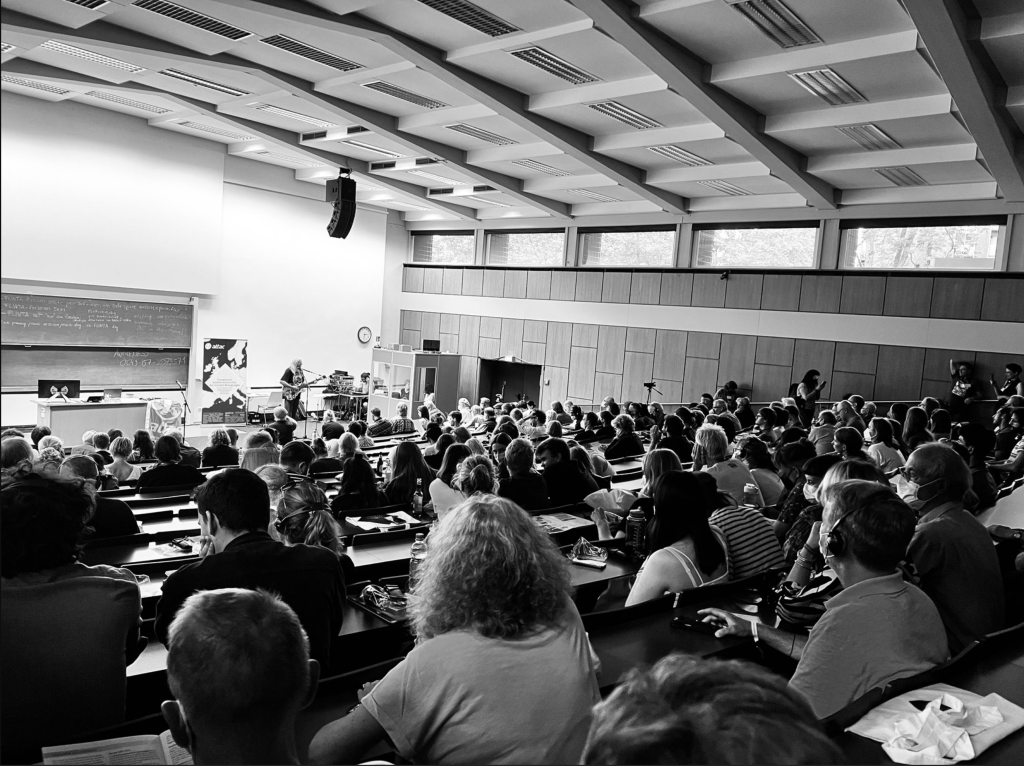
This is a report on our work with Citizens Take Over Europe, an organisational coalition that campaigns for more democracy within the European Union. Its focus, on citizen power through citizens’ assemblies and petitions dovetails with Another Europe’s “Transforming Europe from Below” pillar and campaigns.
We have been represented on the CTOE Plenary since April 2021, and I took over as our representative on it over the summer of 2021.
At the time, the focus of CTOE, was participation in and influencing of the European Union’s Conference on the Future of Europe (CoFoE). This had been established by the Commission; it was a promise from Von Der Leyen as part of her first controversial confirmation process.
The Conference consisted of delegations from the Institutions and a sortition cohort which met in topic panels. I find its final report quite optimistic and wrote several articles on my blog. It covered climate change, health, a stronger economy – social justice & jobs, international affairs, values & rights, digital transformation, democracy, migration, and education, culture & youth. The biggest disappointment is the failure in the Migration chapter to mention safe routes and the preparation for the legitimisation of offshoring migrant processing. Many of its outcomes were incorporated in a resolution of the European Parliament calling for a constitutional reform convention.
CTOE developed relationships with the institutions and some of the sortition delegates. CTOE critiqued the Conference as suffering from weaknesses, most importantly about gender equality, racial minority representation and the role of moderators and experts. Also sadly, some of the citizen proposals were eclipsed by the political party agendas.
At this time, CTOE pushed for a permanent citizens assembly and for more effective petition process, despite the fact that at the time, few recent petitions had achieved the 1,000,000 signature threshold.
The EP resolution asked for co-decision on a series of issues and the weakening of the blocking powers of the Council. It also proposed the extension of EU competencies and called for a Treaty convention. This occurred too late in the mandate and there were insufficient time and impetus for this to go further forward. The impetus was sufficient for the French and German governments to jointly commission a report, as an alternative, proposing a two speed Europe, actually a four speed Europe, with associate membership. The Council never formally said no, and this casualness with the accountability of the institutions is a growing trend.
The EP elections in 2024 represented a shift to the right with the Greens being the main losers, and the European Peoples Party (EPP) led by the German Christian Democrats and European Conservatives and Reformists (ECR) led by the Italian Brothers of Justice, and forces further to the right being the gainers. Von der Leyen, an EPP member was confirmed as President of the Commission by a centre left coalition but is increasingly attempting to build a voting coalition in the Parliament including the ECR. The political locus of the European Parliament is becoming increasingly reliant on the German Centre Right’s refusal to work with the inheritors of its far-right traditions. We should also note that Commission currently has an EPP majority. This is I believe the first time that a European political group has had a majority on the Commission. I hope it does not mark the end of the need for coalitions within the EU’s democratic structures.
CTOE built a political score card for the Euro-elections 2024, and Another Europe worked with Office of the European Parliament to encourage British residents entitled to vote, to do so.
One result of COFOE was the use of Citizen’s Panels to advise on programmatic work of the Commission which has the unique power to introduce laws and proposes the budget. This year they are running citizens’ panels on the budget and preparedness; these are important issues.
CTOE developed a Citizens Assembly Blueprint, which emphasized the need to ensure that citizens voices prevailed, and not those of the organisers. Last year, CTOE co-operated with the European University Institute who ran a prototype citizens assembly, the Democratic Odyssey, which also made recommendations on policy, and on process.
On the convening of the new Parliament, CTOE lobbied for the creation of an “Intergroup” which is a standing all party committee of the Parliament on “Democratic Reform”. The Parliament decided that wine was more important but agreed to establish a shorter longevity special committee on the Union’s democracy plan. CTOE works with members of this committee running seminars on topics of concern to democrats in the Union.
The EU has had a long term Democracy Action Plan, which has been rebadged and amended into a package called the Democracy Shield. This is designed to promote free and fair elections, strengthen media freedom and counter disinformation.
Elections are a matter for member states although COFOE recommended that the institutions review arrangements to ensure that access to the vote was uniform across the Union.
The proposals on Media Freedom cause concern that the laws passed will be aimed at protecting journalists in Eastern Europe and beyond against violence but will be weak in defending journalists from their billionaire owners/employers. This threat potentially recognises a dichotomy within European public opinion. Citizens in Eastern Europe do not trust the state to protect them against ideas, while citizens in the West are concerned about the malevolent and self-interested influence of social media and press ownership.
One of the outcomes of COFOE’s recommendations is the growing realisation of the impact of foreign cyber-activities and its threat to its democracy. This started from concern about disinformation, but other issues contribute to a movement to look at protecting citizens and their democracy and privacy.
Combatting disinformation requires comprehensive cyber-security capabilities and laws. The Digital Services Act gives the enforcement authorities the power and places obligations on the, mainly US, companies to report and react. Much of the political focus remains on the Russian state. It must be recognised that European and British democracy is vulnerable to attacks from both East and West as shown by the Brexit referendum.
While for many, the shocking US policy on Greenland takes a lot of bandwidth in people’s heads, yet partly because of my professional background, equally provocative was JD Vance’s speech to the Munich Security Conference last year (2025). MAGA are and have used a so-called free speech agenda as part of their manifesto to achieve power in the USA and object to Europe’s values and laws that seek to restrict & punish hate speech.
The DSA is one of the targets of the US’s digital colonialism. We should note here that the US Government have denied visitor visas to five European figures, most notably former EU Commissioner Thierry Breton, accusing them of enforcing “extraterritorial censorship”.
There is significant anger in the European Parliament about the use of AI to attack women and girls.
In the UK we need to consider the UK government’s seeming ambivalence on digital colonialism, and while a lot of noise is being made about Grok and others’ assaults on women, the equally important question of electoral interference is not being addressed.
The concerns and demands of the British labour movement on relations with the EU have always been economistic, and remain focused on trade, with consumer & environmental demands being secondary concerns with silence on digital liberty/protection. This is an opportunity to argue that the UK’s moves towards the single market should include agreement to adopt the Digital Services Act, together with the GDPR and the AI Act. The opportunity is provided by the 2026 review process required by the Trade and Cooperation Agreement.
AEIP must argue that the government should be seeking to join the European Union single digital market and implement the DSA in the UK. It should also argue for membership of the customs union and single market now, and call on the political parties to commit to rejoining at the next election.
Over the last three years, several ECIs have achieved the 1,000,000 signatures necessary to mandate a response from the Commission. Their track record is not good as the response to the “End the cage age” petition is exceptionally weak almost certainly due to corporate lobbying. We will work with other civil society organisations to ensure a positive response to the outstanding petitions, which include, “My Voice, my choice”, on access to abortion, “Stop abandoning video games”, restricting video games publishers from walking away from their games, Ban on Conversion Practices in the EU, Cohesion Policy for the Equality of the Regions and Sustainability of the Regional Cultures, and a Fur Free Europe.
The growing need for democratic oversight on the growth of defence budgets and the growing defence cooperation within the European Union is obviously both an opportunity and a threat to democracy within the Union and its member states, as oddly are the outcomes of talks on the future of the Euro and a common tax jurisdiction.
CTOE through one of its working groups is looking at what sort of constitution the EU needs. It believes that copying the US constitution would mean copying its weaknesses such as the Senate, tax collecting duties and the singular executive. AEIP argues for broadening the principle of subsidiarity to become a citizen right, not a member state right, and for a more democratic Committee of Regions.
The European Council, and the member states, are frightened of a treaty convention, which is why developments that lead to a two speed Europe, are being considered again. CTOE seeks to establish the idea of a citizens’ assembly as part of the treaty revision process. It is unlikely that any convention will be held and that any developments will follow the previous precedents of de-facto Council subcommittees. There remains some controversy about the omnibus laws, which seek to rollback reforms on the digital economy and climate change regulation. A further centripetal effect on the institutions’ inclusiveness is the proposed reforms to the financial & banking sector.
This is an opportunity for democrats. We should continue to work with CTOE.
Further reading:
https://www.europarl.europa.eu/resources/library/media/20220509RES29121/20220509RES29121.pdf – the Final Outcome of COFOE
https://davelevy.info/tag/cofoe/ – Dave Levy on COFOE
https://davelevy.info/the-end-of-fortress-europa/ by Dave Levy, I am not sure that what has happened justified my contemporary optimism
https://citizenstakeover.eu/blog/our-democratic-manifesto-for-the-european-elections/ by CTOE
https://democraticodyssey.eui.eu/home about the democratic odyssey
https://share.google/aimode/bWRbDbv9geUAxJg0Y Gemini on recently successful ECIs
The ECI title, “Ban on Conversion Practices in the EU”, is a confusing title in English. They say “We call on the European Commission to propose a binding legal ban on conversion practices targeting LGBTQ+ citizens in the European Union: – Conversion Practices are interventions aimed at changing, repressing or suppressing the sexual orientation, gender identity and/or gender expression of LGBTQ+ persons”. Presumably without consent.
On funding counter disinformation, expenditure on EU enforcement is low compared to what member states and the UK spend. The UK’s NCSC spends £1.9 bn, Europol €241m, a total number, cybercrime is not identified separately, and ENISA only €26.9 million. ENISA is inadequately funded, Europol less so, and the member state security services even less so, although none are funded to the extent of Trumps ICE and the NSA.
27th February 2026